Posts

Teaching the Next Generation

Image
Last year the Finnish Cultural Foundation announced a new Mullankaivajat ("soil diggers") grant, which was applicable for archaeological projects organized in cooperation with schools around Finland. It aimed to bring archaeological research closer to the life of the local children and make them more aware of the history that surrounds them. The grant has already led to multiple excavations around the country and it's no surprise that our trial excavation team got involved with a project as well - this time in Kontiolahti. In Kontiolahti, we joined a project organized in cooperation with the National Museum of Finland and the Association of Cultural Heritage Education in Finland. Before our arrival the project team had already visited the local school and told the children of various age about the site they were about to research - the house of the local smith Tobias Takkunen from the 19th century. Children came to the site in small groups and took part in four...
Hidden Among the Planks

Image
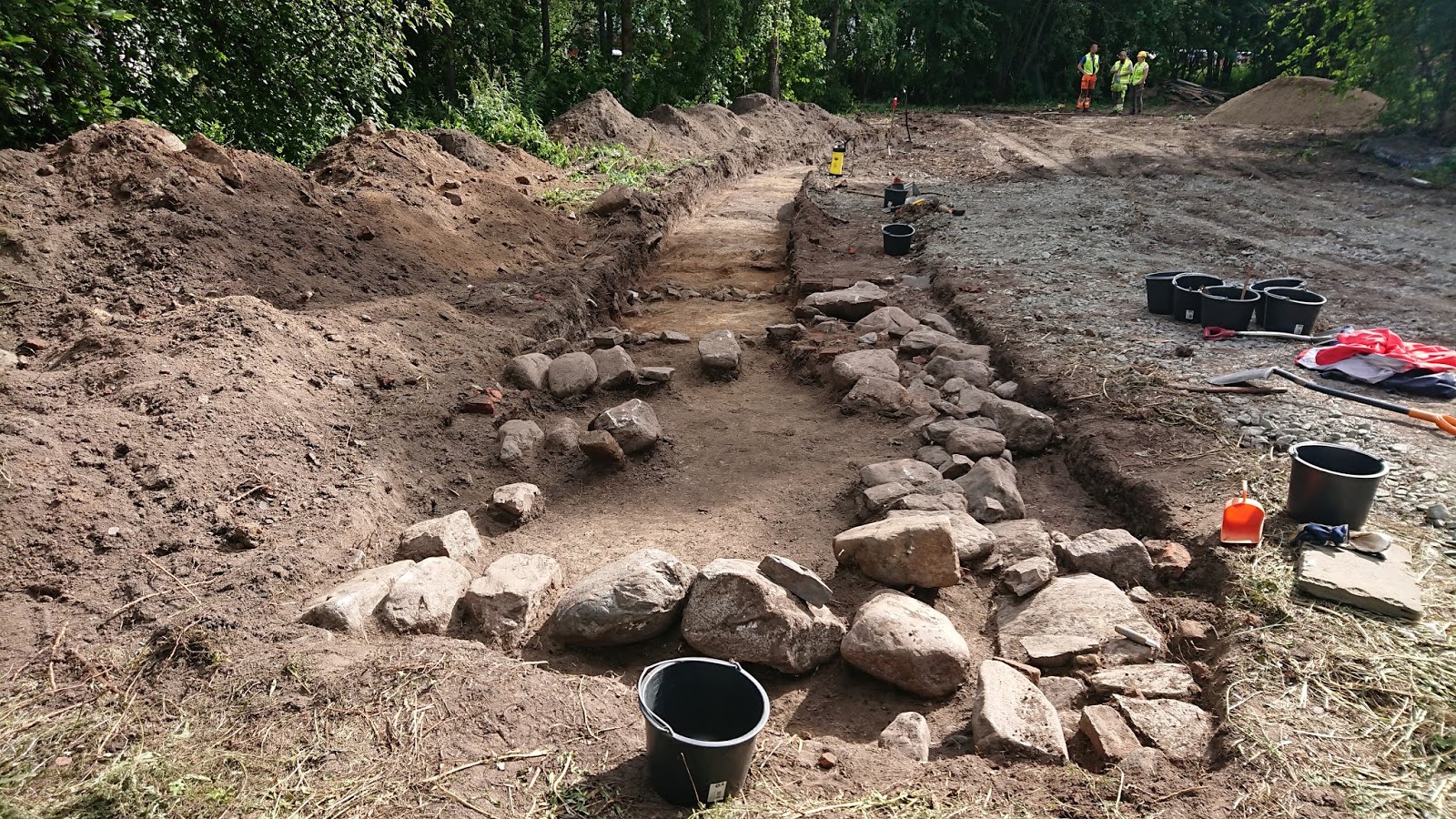
As mentioned before, a typical job for the trial excavation team is to conduct small-scale trial excavations in areas that have potential archaeological heritage but are falling under land use. Based on trial excavations, building projects can be halted until further research is conducted or, if possible, a potential area for the construction is found from an area that wouldn't disturb the archaeological heritage. This time our work sent us to further north and after hours of driving, we ended up in the city of Tornio right by the Swedish border. In Tornio, our mission was to dig test pits and trenches around an empty lot, that would soon fall under further land use. As it’s typical to change the soil for the entire lot when building residential buildings within cities, the whole lot had to be checked for archaeological heritage. This time we couldn’t just find the most suitable place for the building, but rather had to find out if further excavations were needed and if so, to...

Mesolithic Paradise

Image
Three weeks in Keitele are finally over and the excavations were conducted successfully to the end. While our days in the trenches remained scorching hot due to the unusually long heatwave, the nearby lake provided some comfort and the multitude of finds kept our spirits high! Even though the finds are still waiting to be examined and the report to be written, I can share some initial thoughts of the excavations at this site that proved to be a Mesolithic paradise to any Stone Age archaeologist. Fire place from the first week getting slowly uncovered. As we had opened three trenches on the first week, we continued the work on all three areas, while also opening some smaller test trenches to see the extent of the archaeological potential. Photo: Sara Perälä The site continued to be rich in finds, although the variety of them was as narrow as expected from a Mesolithic site in Finland. Basically, almost all finds could be divided into two categories - animal bones and quar...

On the Road Again

Image
For an archaeology students, job opportunities are often scarce and sprinkled around the country, with a contract typically lasting only for the duration of a single excavation. It's also typical that the job ads appear only a few weeks before the said excavation, making it stressful to wait for potential work offers. That's why I've been glad and humbled to have a fixed schedule from early on, and while I have barely had a few days of holiday during summer, I happily moved straight from Hanko to the  beginning of the next journey of my summer – this time within the Finnish Heritage Agency. As it's said on their website, the Finnish Heritage Agency preserves Finland's material cultural heritage: collects, studies and distributes knowledge of it. They have various departments from museum services to preserving cultural environment and handling research permits for archaeological excavations. My position for the next three months will be within the trial excavati...

Uncovering the WWII Hanko, week III

Image
Three weeks in Hanko went past faster than I expected, but luckily the finds continued numerous during the last week and the new crew made exciting discoveries each day. For this last week, we concentrated our efforts on e xcavating a sizable trash dump within the Ukrainian prison camp, uncovering layers rich in a variety of finds - porcelain, coins, buttons, combs and a lot more. Meanwhile I led a small task force to finish the excavations at the German Red Cross (DRK) trench, which required still a fair bit of work even after three weeks of excavations. "The Graveyard of Bottles" So far all the trenches we've opened have been a bit different in the type of finds, but with these two trenches the difference was even more clear. While the finds of the Ukrainian prison camp included a lot of personal items, such as a mess tin with its owner's initials carved on it and even a SA Sports Badge, the finds from the DRK trench were very different in style. During the...

Uncovering the WWII Hanko, week II

Image
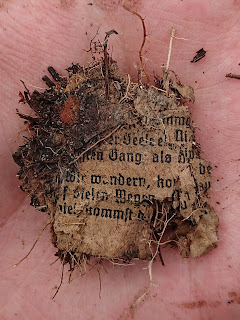
Trenches had lots of fragments of books, tobacco packages and official documents. Yet another week in Hanko is coming to an end and another group of helpful volunteers has left the site for their homes. This time we opened two completely new trenches while the work at the German Red Cross site continued. If you're interested in seeing photos of the many finds made during the week, check out Jan Fast's blog starting from this post . My duties were similar than on the week before and the trenches kept me busy, as the find were numerous and we had much more participants than on the first week. The finds were also quite different in style and it was a pleasant surprise to uncover multiple pieces of German writings as well as fairly well preserved textiles. At the same time, the tin cans that we had gathered hundreds during the first week were now almost non-existent. Metal detector showed it prowess again during the week, as it gave as a clearer picture on the concentr...

Uncovering the WWII Hanko, week I

Image
After six weeks in Pori, it was time to move on and relocate myself to a bit more familiar area - Hanko, the southernmost city of Finland. There I was to spend the following three weeks excavating the remains of a German transition camp from the WWII. It was a site that had seen a considerable amount of research for the past four field seasons, and now it was time to wrap up the excavations for the time being. The expectations and hopes were high and the first week truly didn't disappoint! The German camp in Hanko served as a transition camp during the Continuation War, receiving and sending off German soldiers on their way to Lapland and back. It was a massive complex with thousands of soldiers flowing through every day, and while most of the buildings have since been demolished, a few barracks still remain. However, even if the area has since been mostly overtaken by nature, lots of remains of the activities are still hidden underneath the topsoil and the stories that these ...